Grade reality.
Not behavioral theater.
Upload a repo, take-home, or private codebase. Clyris breaks down the actual engineering, architecture, depth signals, production-readiness, and generates interview questions from their real code. Before you even schedule the call.
Engineering assessment is BROKEN.
83%
of engineering interviews
yield no hire
$31k
average cost
per engineering hire
~6hrs
of engineer time
per candidate rejected
You're drowning in noise.
Code is Abundant
AI tools generate perfect syntax in seconds. The technical tests and take-homes that used to take hours are now bypassed entirely.
Resumes are Fiction
LinkedIn profiles and self-reported titles are inflated. You spend hours filtering through candidates who look identical on paper.
You're grading theater.
Behavioral Black Boxes
"AI-native" assessments force candidates into browser IDEs to grade how often they 'push back' against AI. It's highly gamable.
Candidate Burnout
If every company requires a 3-hour simulated AI behavioral test, the best candidates will simply opt out. It's the new whiteboarding test.
Yourpipelinerunsonresumesandgutfeel.Clyrisreadswhattheyactuallybuilt,andsurfacesthesignalyou'donlygetaftera1-hourinterview,beforeyouschedulethecall.
See the truth in action.
Watch how Clyris extracts architectural signal from raw code in seconds.
Platform Walkthrough
3m 38s
"But evaluating code is meaningless now."
We hear this a lot. And you're half right.
We don't grade syntax. We expose architectural fault lines.
Code is abundant. AI can write perfect syntax, but it can't fake system-level ownership. If you look deeply, there is a clear difference between a junior prompting an AI and a senior guiding one. Clyris looks past the surface to expose mocked databases, ephemeral state, and hardcoded logic masquerading as architecture.
What you stop doing when you hire this way.
The interviews don't disappear. They just start from actual knowledge instead of hope. Fewer loops. Stronger bar. Faster close.
Stop screening resumes
Resumes tell you what candidates want you to think. Code tells you what they can actually do. Clyris makes repos the first filter, not the last resort.
Stop running coding rounds
LeetCode is coachable. System design is memorizable. Questions built from a candidate's own code can't be rehearsed, only answered by someone who wrote it.
Stop adding rounds to compensate
Teams pile on interviews when early signal is weak. Strong early signal means one focused conversation instead of four exploratory ones.
From code to hiring decision.
How real work turns into a clear hire/no-hire call.
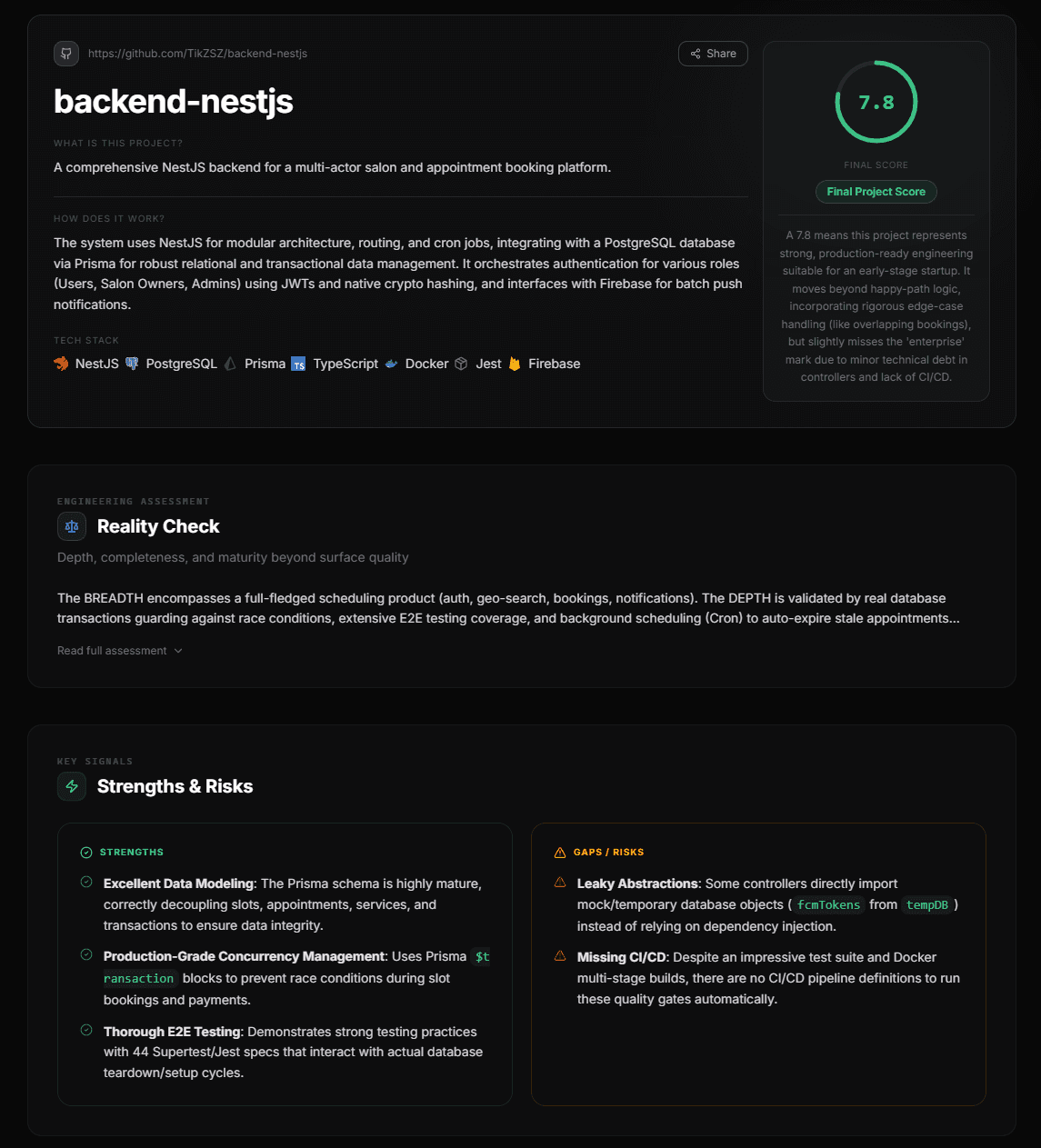
Every repo gets a real read.
Upload any codebase, public GitHub repos, private take-homes, or ZIPs. Clyris cross-references their resume and LinkedIn, validating their 'can do X' claims against the raw complexity of what they actually built. Architecture, depth, and production-readiness, mapped with evidence from the code itself.
- Architecture, depth, and production-readiness mapped.
- Strengths and gaps surfaced with evidence from actual code.
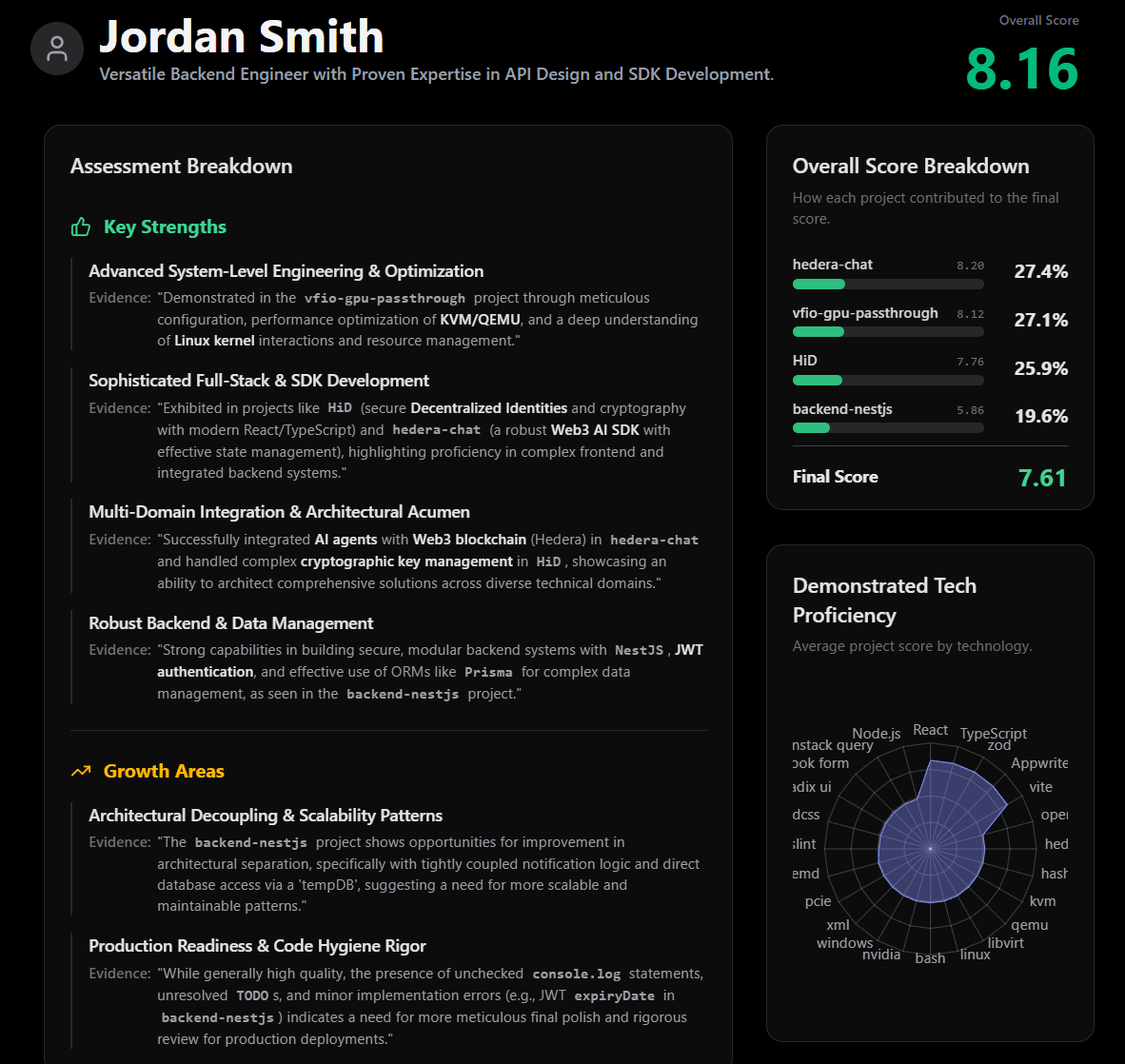
All their work. One read.
Analyze multiple repos for the same person. Clyris synthesizes them into a single view, determining overall signal, seniority, and what actually matters.
- Clear candidate summary with final judgment.
- See which projects drove the signal, and why.
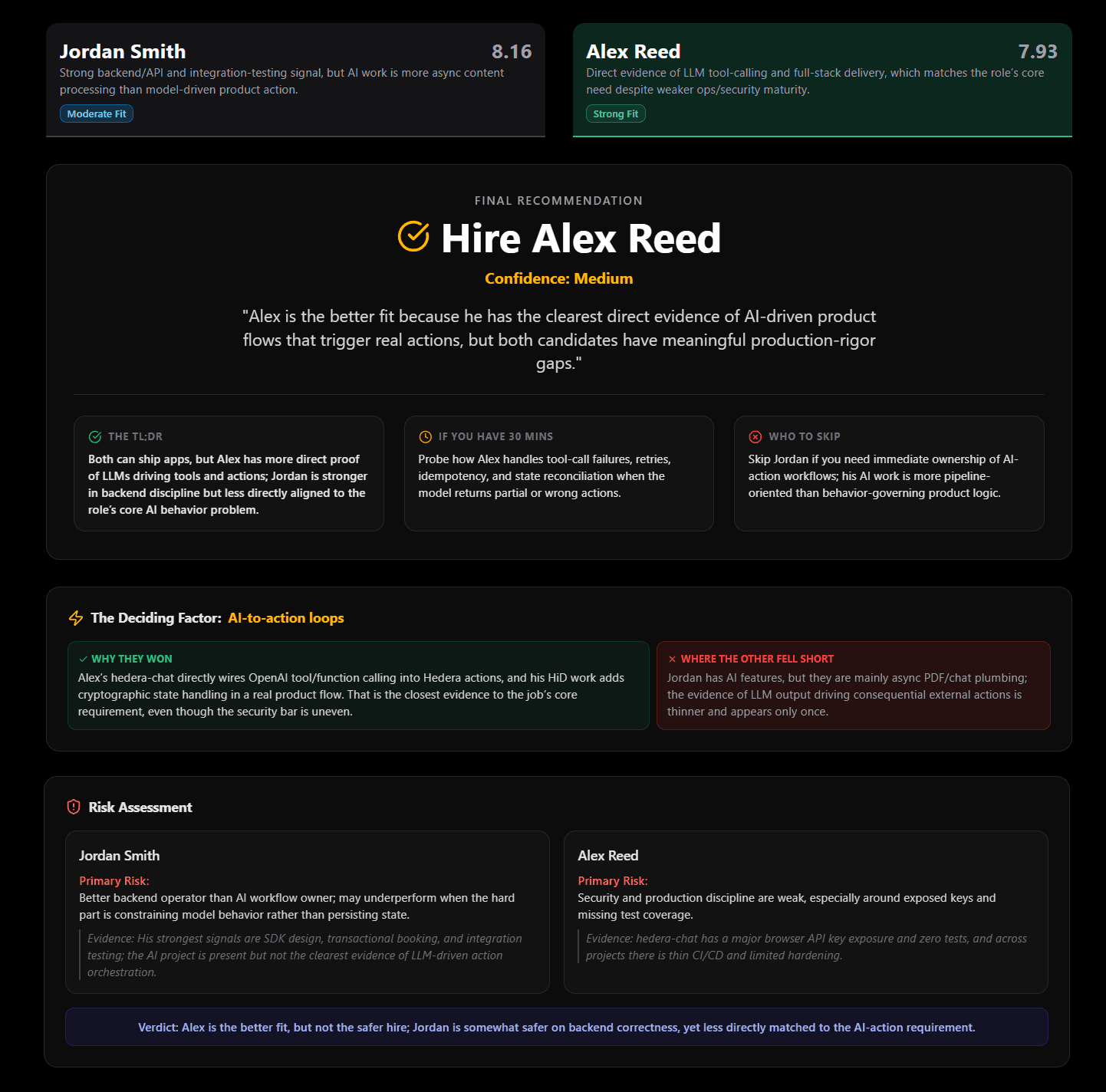
Your pipeline. One decision.
Candidates ranked against each other and the role. One output: who to hire, who to skip, and why, with the deciding factor and confidence level.
- Side-by-side comparison grounded in real work.
- Everything distilled into a single hiring brief.
The anatomy of a surgical interview.
Your pipeline culminates here. We generate a custom grilling script built exclusively from the fault lines in their code, probe ownership, not textbook knowledge.
You're publishing a UserCreated event to Kafka immediately after saving to Postgres. If the Kafka broker goes down, the database commits but the event is lost. How would you redesign this to guarantee eventual consistency?
Code evidence: Line 112
async function createUser(payload: CreateUserDto) {
  // 1. Commit to primary database
  const user = await db.users.insert(payload).returning('*');

  // 2. Publish event to Kafka
  // BUG: If this fails, the user exists but downstream
  // services (billing, emails) are never notified.
  await kafkaProducer.send({
    topic: 'user.created',
    messages: [{ value: JSON.stringify(user) }],
  });

  return user;
}
What to listen for
Strong Signals
Mentions the Transactional Outbox Pattern (saving the event to a Postgres table in the same transaction, then using a background worker or CDC like Debezium to publish it).
Red Flags
Suggests wrapping it in a simple `try/catch` block and retrying inline, which blocks the API thread and still loses data if the pod crashes.
Before the call, you already know where to probe.
From 3 hours of guesswork to a 5-minute brief with exact fault lines.
The old way
3 hours. Zero signal.
You spend 3 hours reviewing a take-home that an AI wrote in 5 minutes. You ask generic behavioral questions because you don't know where the architectural fault lines actually are.
Blind to Context
Is this state management scalable? Who knows. The tests passed and the UI looks fine.
Generic Interviews
"Tell me about a time you solved a hard bug."
"What is your biggest weakness?"
With Clyris
5 minutes. Surgical precision.
You get a 5-minute brief exposing exactly where the architecture falls apart. You hand your team a surgical grilling script tailored precisely to what they built.
Observation: Concurrency
Candidate used connectOrCreate inside a transaction without explicit row locking, risking overlapping bookings.
Instead of generic questions, you immediately probe their understanding of serializable isolation and database constraints.
Start with the Project layer. Unlock the Full System.
What you can use today is the core engine Clyris runs on. The full product builds on top of it, ranking candidates, comparing them, and making clear hiring decisions.
Analyze real code
Get a scored breakdown of how the project is built, what it signals about the engineer, and what to ask in an interview.
- Upload repos or take-homes from GitHub, GitLab, Bitbucket
- Scored project analysis with engineering assessment
- Key signals: strengths, gaps, production-readiness
- Interview questions generated from real code
- Free plan available · pricing for higher volume
Current scope limitations
- –Project-level only, no synthesis across multiple repos
- –No ranking or comparison across candidates
- –No job description alignment
Make hiring decisions, not just evaluations
Built on the same analysis layer, adds candidate synthesis, ranking, and clear decisions across your pipeline.
- Candidate-level synthesis across multiple repos
- Ranking across candidates against your role
- Clear comparison: who to advance, who to skip, and why
- Structured interview brief built from actual code
- Final recommendation with confidence and deciding factors
- Volume discounts
The analysis layer is fully usable today. The full system expands it into complete hiring decisions.
What if you could run your best interview questions on their code, before you schedule the call?
Find it. Read it. Rank it. Then have one interview that actually matters.
5 free analyses · No credit card · Built for teams hiring engineers